Why your scraping infrastructure should be yours
SaaS scraping APIs are convenient, until they aren't. Here's why owning your scraping infrastructure gives you better control, lower costs, and real data ownership.
You're three days into a side project. You've got a scraping pipeline pulling product data, feeding a small LLM, returning clean summaries. It works. You're happy.
Then you check your dashboard and realize you've burned through 80% of your monthly credits. It's the 9th.
If you've been there, you already know where this is going.
Web scraping APIs have become remarkably polished over the last few years. They handle JavaScript, rotate proxies, deal with CAPTCHAs, return clean structured data. Impressive stuff. But the model most of them sell you on has a quiet cost that rarely comes up in the docs: you're renting access to critical infrastructure you don't own, can't configure, and will pay more for as you grow.
This post is about why that's worth thinking carefully about, and what the alternative actually looks like in practice.
The credit problem nobody talks about
Scraping APIs typically charge per page. Sounds reasonable until you think through what it means for your actual usage patterns.
You're building a price monitoring tool. One run across 10,000 product pages. At a generous rate of 1 credit per page, that's 10,000 credits before you've even set up your pipeline. Add retries for failed requests, recrawls for stale data, development and testing calls, and you're looking at a multiplier that most pricing calculators conveniently don't model for you.
The result is a cognitive tax that sits on every engineering decision. How many pages should I crawl this run? Should I cache more aggressively? Is this test worth the credits?
This isn't just about money. It's about the friction that gets introduced into your development process when infrastructure isn't something you own and control.
When you run your own scraping stack, you pay for compute. That's it. A job that costs $40/month in API credits might cost $4/month in cloud compute. The gap widens fast as you scale.
Your data passes through someone else's servers
This one tends to get skipped in the "should I use a managed scraping API?" conversation, but it's worth naming directly.
Every URL you send to a managed scraping service, every page you fetch, every dataset you build, passes through infrastructure you don't control. The scraping provider can see your targets, your timing patterns, what data you're collecting, and how your pipeline is structured. Most reputable services have privacy policies that say reasonable things about this. But "reasonable policy" and "zero exposure" are not the same thing.
For many use cases, this is completely fine. But if you're:
- Scraping in a competitive intelligence context
- Building a data product where your sources are a genuine business asset
- Operating in a regulated industry with data residency requirements
- Just generally cautious about handing a third party a map of what you're watching
...then owning your scraping infrastructure isn't paranoia. It's just sensible.
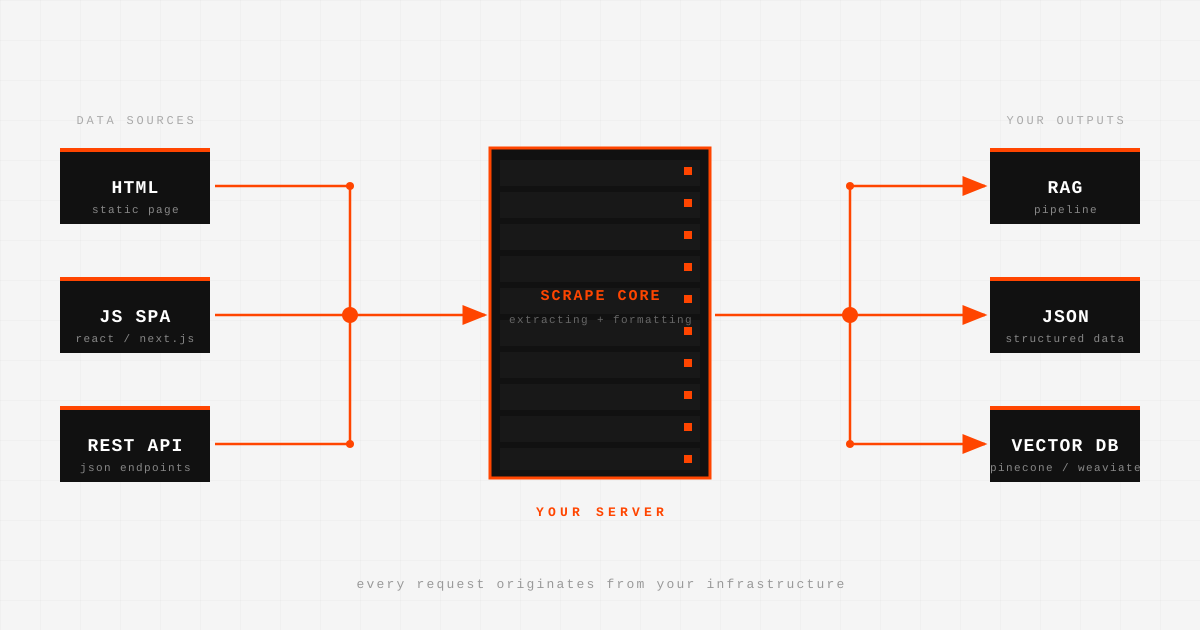
Self-hosted means your requests originate from your infrastructure, go directly to your targets, and the data lands in your storage. No intermediary with a view into your pipeline.
Lock-in is subtle until it isn't
When you build on a SaaS scraping API, you're writing code against their specific SDK, their output format, their authentication model, their rate limit behavior. This is fine day one. By month six, that integration is woven into your codebase.
Then one of several things happens:
- They raise prices (it happens, growth companies need revenue)
- They deprecate the endpoint you're using
- They get acquired and the product roadmap shifts
- They go down during a critical batch job
At that point, "just switch to something else" is not a weekend project. It's a migration. And migrations are expensive.
With a self-hosted, open-source scraper, you own the code. You can fork it, modify it, upgrade it on your schedule, and run it anywhere Docker runs. The exit door is always open.
Self-hosting isn't what it was
The practical objection to self-hosting scraping infrastructure used to be real: you had to stitch together headless Chrome, proxy rotation, CAPTCHA handling, request queuing, and retry logic yourself. It was weeks of work before you scraped a single page cleanly.
That's no longer the case.
Modern open-source scraping stacks handle all of that. Headless browser orchestration, residential proxy rotation, JavaScript SPA rendering, clean Markdown and JSON output. These aren't hard problems to solve yourself anymore. They're solved problems packaged in a Docker container you can run in under five minutes.
The infrastructure you'd have been justified in outsourcing two years ago is now something you can own without meaningful operational overhead. The calculus has shifted.
What self-hosted actually looks like
Let's make this concrete. A self-hosted scraping setup in 2026 looks something like this:
docker run -p 3000:3000 tentacrawl/tentacrawl
Your stack handles:
- Browser orchestration: headless Chromium, JavaScript rendering, SPA support
- Anti-bot measures: CAPTCHA bypass, proxy rotation, request fingerprinting
- Output formatting: clean Markdown for RAG pipelines, custom JSON schemas for structured extraction
- AI integrations: native output formats for LangChain, LlamaIndex, and direct vector DB streaming
You call it from your code the same way you'd call any API:
import requests

response = requests.post("http://localhost:3000/scrape", json={
    "url": "https://example.com/products",
    "output_format": "markdown"
})

clean_markdown = response.json()["content"]
The data goes from target page to your code without touching anyone else's infrastructure. You control the rate limits, the proxy configuration, the retry behavior, the output format. It scales when you do, costs what compute costs, and doesn't have a credit meter running in the background.
The practical trade-off
Self-hosting isn't for everyone, and it's worth being honest about that.
If you're running a one-off scrape for a small project and you never want to think about infrastructure, a managed API is a completely reasonable choice. The convenience is real.
But if you're building something that depends on scraping as a core function — a data pipeline, an AI product, a monitoring tool — treating that function as infrastructure you own rather than a service you rent is worth the modest setup cost. The long-term economics are better, the operational control is better, and the data stays yours.
The scraping layer of your stack shouldn't be the one thing you can't look inside.
Where to go from here
If you want to try running your own scraping infrastructure, TentaCrawl is open source and designed to get you running in minutes, not days. The GitHub repo has a quick-start guide, Docker setup, and examples for common use cases: RAG pipelines, structured extraction, LangChain integration.
No API key required. No credit meter. Just your infrastructure, your data, your pipeline.
Built something interesting with self-hosted scraping? We'd love to hear about it. Follow us on LinkedIn or open a discussion on GitHub.